Make the Forest Your Agent's Memory
Ten typed tools over MCP, a skills file that teaches the agent the terrain, and one scoped key per agent: how a self-hosted forest becomes memory your agents can search, walk and grow.
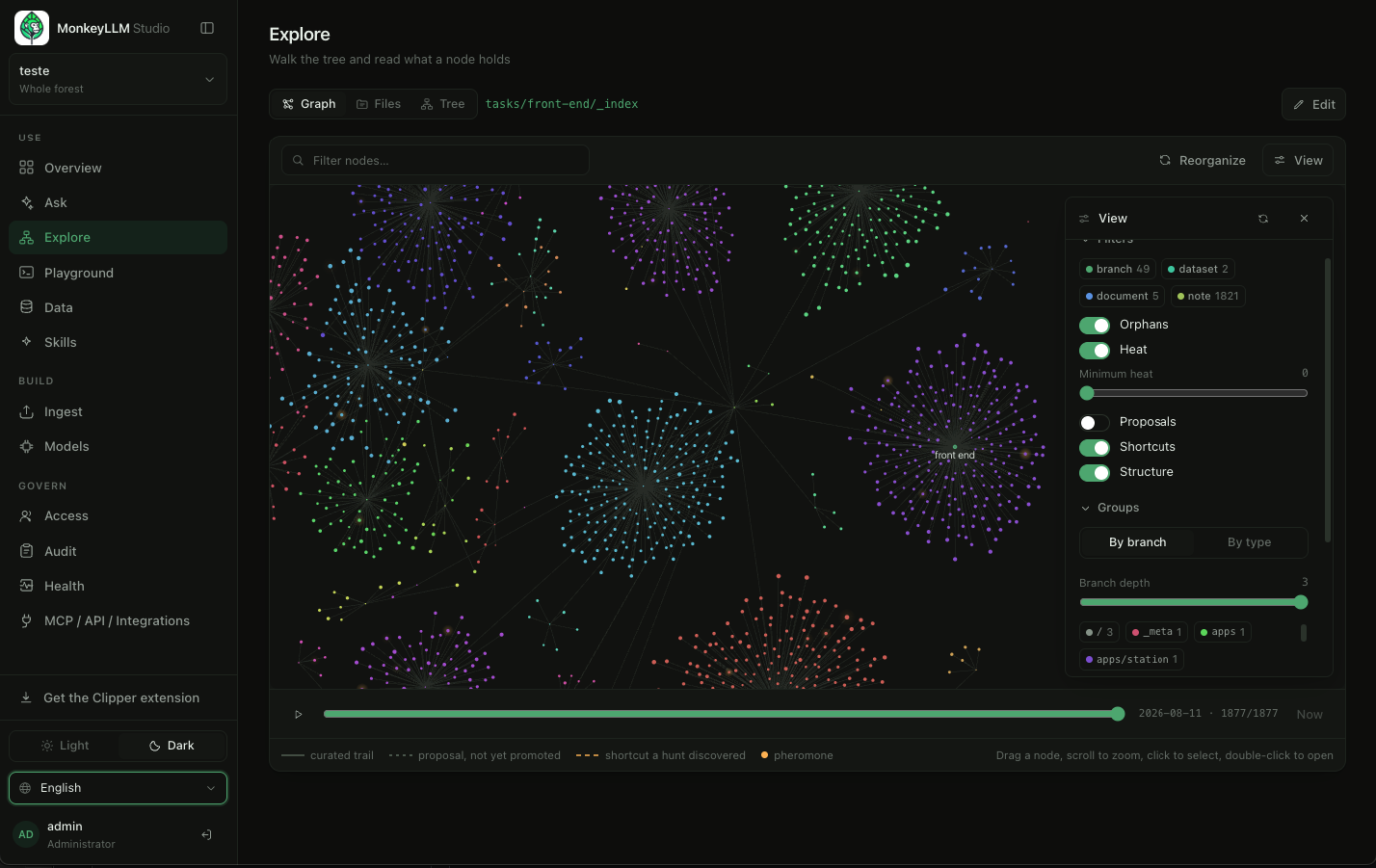
Agents wake up empty. Whatever your agent figured out yesterday is gone from today's context window, and pasting old transcripts back in does not scale past a week. This guide walks through wiring a MonkeyLLM forest into an agent over MCP, so the agent gets a memory it can search, walk and grow.
Ten typed tools over MCP
A forest (a linked graph of small curated notes, each carrying a passport of title, summary and tags) is exposed to agents through the Model Context Protocol as ten typed tools. Typed is the operative word: the agent is not handed a generic query box, it is handed verbs with schemas, and every hop it takes is token-budgeted.

The ten tools group into three moves:
- Navigate: enter through search, read a label, follow a link, open only what is needed. In plain English, walking the shelves yourself instead of accepting whatever the librarian guessed.
- Plant: commit new knowledge as new nodes. This is the memory-forming move, the agent writing down what it learned so the next session starts ahead.
- Pheromone: successful hunts deposit traces and mint shortcut links, so paths that keep paying off get shorter. Plainly: a trail worn into the grass.
The tool-by-tool reference is in the MCP docs, and the underlying node and link model is in the primitives docs.
The skills file teaches the terrain
Connecting ten tools is half the job. The other half is the skills file, the instruction file that makes the forest an agent's memory: it teaches the agent what this forest contains, how to enter through search, when to walk versus when to plant, and to cite the nodes an answer stands on. Drop it into your agent's instructions and the forest stops being ten unfamiliar tools and becomes a place the agent knows how to inhabit.
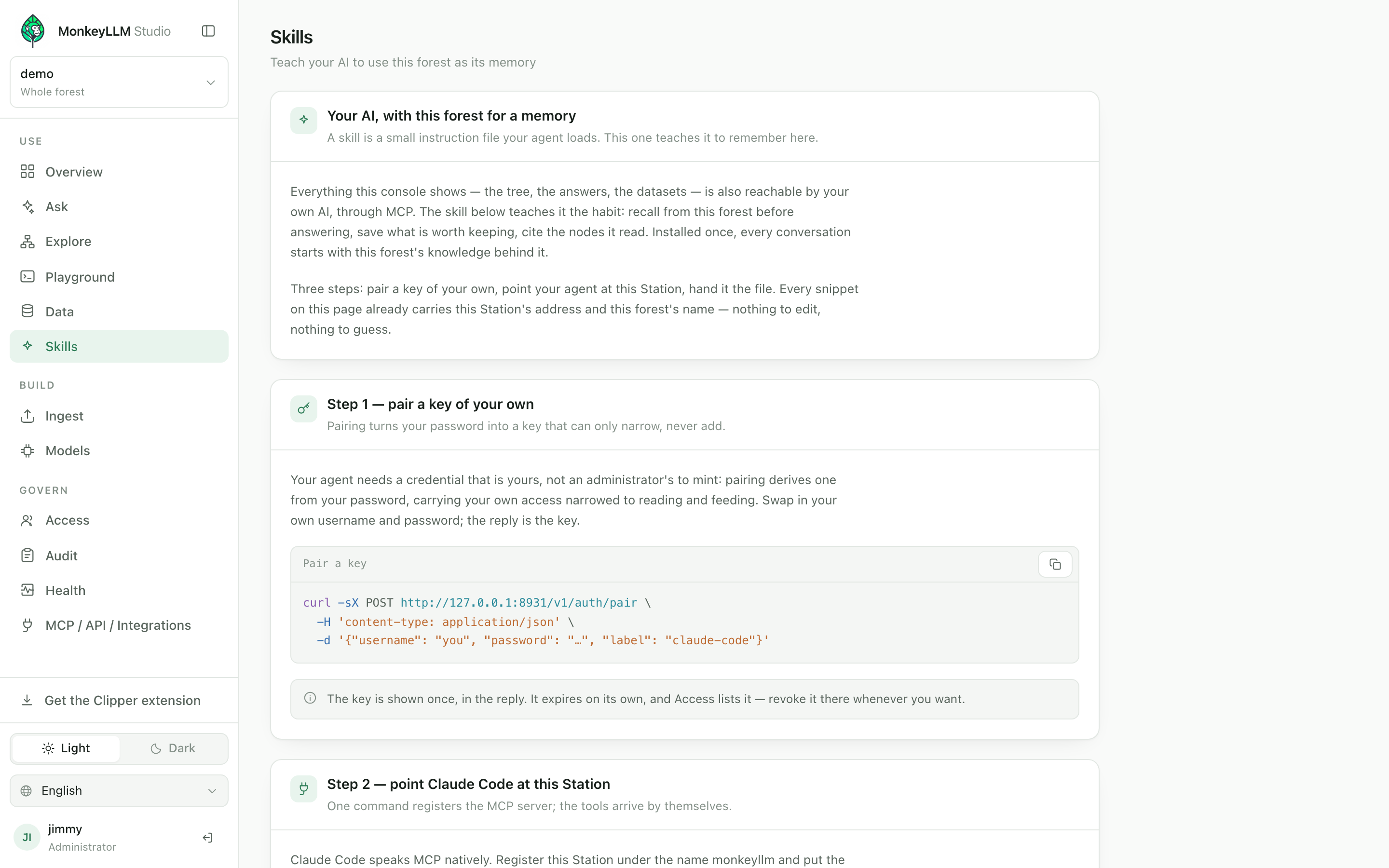
One scoped key per agent
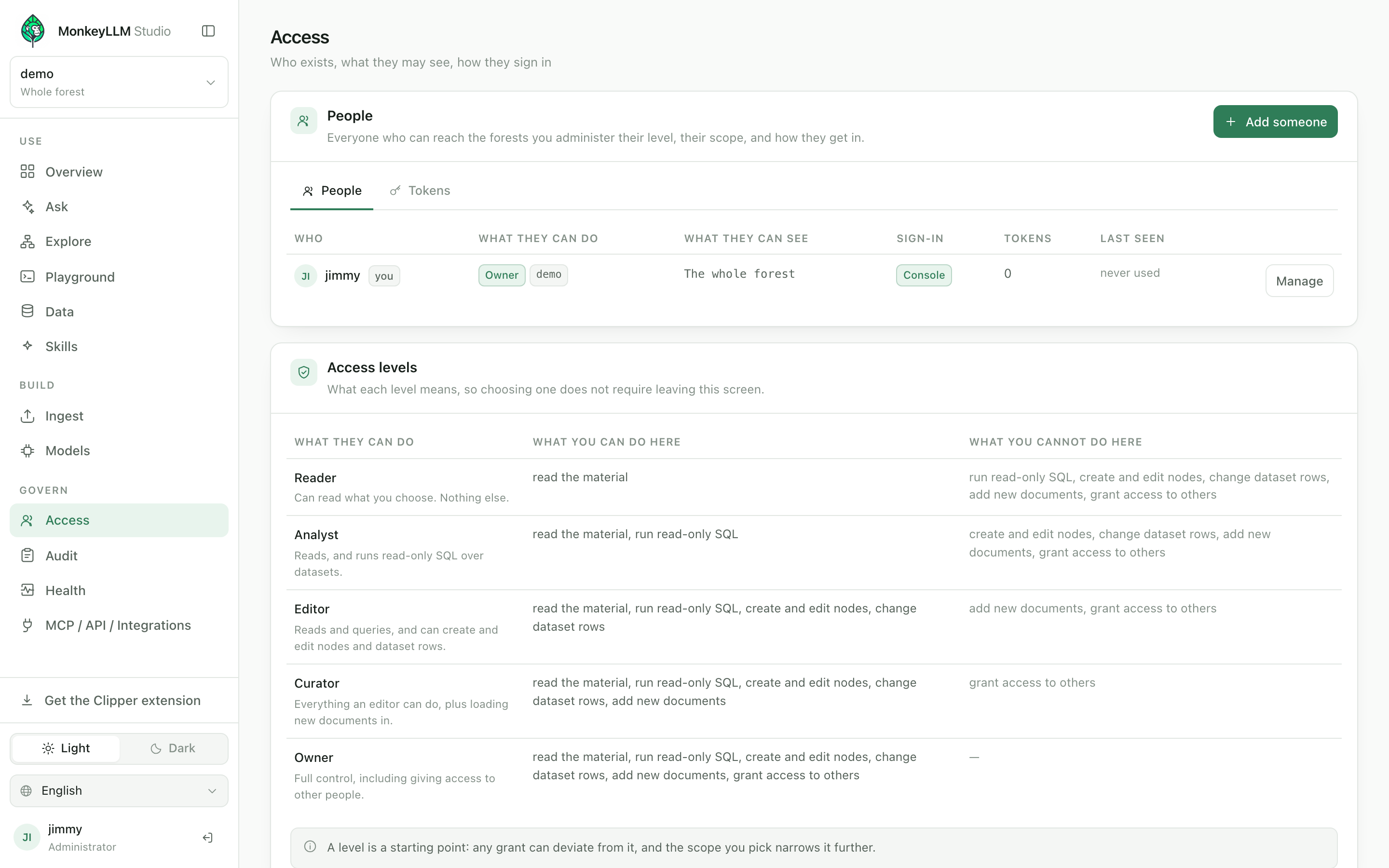
Do not hand every agent the owner's key. The People screen manages access as one row per person or agent, with scoped keys and live tokens: a research agent can read and plant, a reporting agent can only read, and either can be revoked without touching the other. Your forest is a vault: self-hosted, keys under your control, data never leaving your infra.
What the wiring buys, measured
On our strictly multi-hop benchmark (11 questions, each needing at least 3 chained hops), the same 12B local model scores 0/11 as a classic top-k RAG reader and 11/11 as a forest navigator, spending 0.58x tokens per correct answer against an iterative-RAG baseline at 8.4 s p95 versus the baseline's 17.5 s. The full comparison is in agentic RAG vs budgeted navigation.
The same report also keeps its failure: the trail-learning convergence criterion was not met (hops fell by roughly half the threshold), and it is written down, not dropped. If a system is going to hold your agent's memory, prefer the one that publishes what did not converge; here is why we keep that section.
Give an agent a memory
Deploy in four commands, mint a scoped key, hand your agent the skills file, and watch it plant its first node. Start with the MCP docs, read the preprint linked from monkeyllm.com, and star github.com/JimmyWesley/MonkeyLLM if the design earns it.